Ovdje počinje šuma
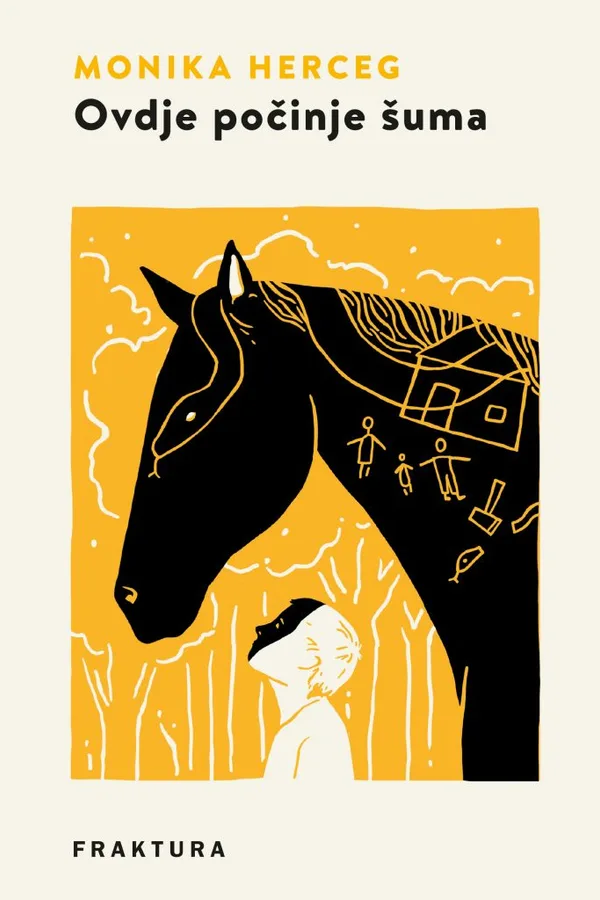
Her first novel — a lyrical, unsparing story of a childhood in poverty, family silence and violence, and of a voice built from everything that was left unsaid.
Read more →Poetry, plays, a first novel, and her books in translation.
Poetry, plays and a first novel. Her plays and translations are on the publications page.
Her first novel — a lyrical, unsparing story of a childhood in poverty, family silence and violence, and of a voice built from everything that was left unsaid.
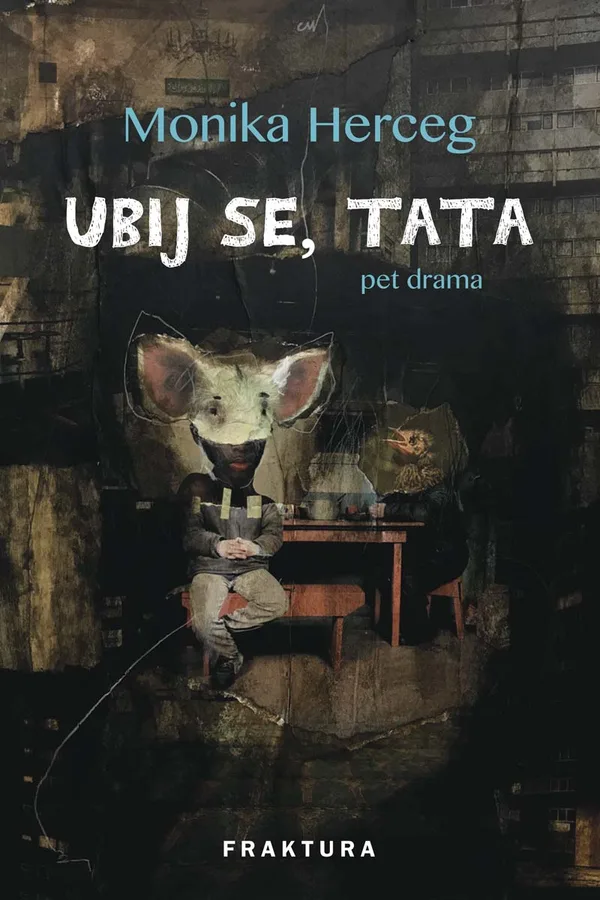
Read more →Five intimate, lyrical plays about dysfunctional families, poverty and class — and, above all, the longing to be loved. The title play won the Marin Držić Award.
Read more →Her third collection, where everything begins with an image of silence creeping in like a centipede. Winner of the Zvonko Milković Award.
Read more →Her second collection, awarded as the best unpublished manuscript in 2018 and reprinted within a year — a rare thing for a book of poems.
Read more →Her debut — fifty-eight poems that read as one unbroken poem about family belief and mythology, inheritance, change and forgetting. Winner of the Goran Award for Young Poets.
Read more →Her first play — three generations of women in a village still living with the war — chosen unanimously from 166 entries and premiered at the Croatian National Theatre in Zagreb.
Read more →A poetic play about why we need love, told through couples whose lives unfold over time. Awarded by the National Theatre Mostar, and since staged and broadcast as a radio drama.
Read more →A play about the wartime evictions of 1941 and 1991 — and how the same mechanisms of violence and forced displacement return whatever the ideology or system.
Read more →The English edition of Lovostaj — poems that fuse physics with politics to name what women the world over are forced to live with.
Read more →The English edition of her award-winning debut, translated by Marina Veverec.
Read more →The German edition of Lovostaj, translated by Ivana Pajić.
Read more →A selection of her poems in French — her first book in translation.
Read more →Mary Shelley
Frankenstein — and with it, science fiction
Mary Shelley began Frankenstein at eighteen, during a ghost-story contest on the shores of Lake Geneva in 1816. Published anonymously in 1818, her tale of a scientist who builds a living creature and then abandons it is often called the first science-fiction novel.
Frankenstein — and with it, science fiction
Cecilia Payne-Gaposchkin
Showed stars are made mostly of hydrogen and helium
In her 1925 doctoral thesis, Payne read the spectra of stars and showed they are overwhelmingly hydrogen and helium. She was persuaded to call the result “almost certainly not real” — until it was confirmed four years later. She went on to become the first woman to chair a department at Harvard.
Showed stars are made mostly of hydrogen and helium
Virginia Woolf
A Room of One’s Own
Drawn from two lectures given at Cambridge’s women’s colleges in 1928, A Room of One’s Own argues that “a woman must have money and a room of her own if she is to write fiction.” Its imagined Judith Shakespeare, the playwright’s equally gifted sister, became a touchstone of feminist criticism.
A Room of One’s Own
Lise Meitner
Explained nuclear fission
With her nephew Otto Frisch, Meitner gave the first physical explanation of nuclear fission in 1939: the uranium nucleus had split in two, releasing enormous energy. Otto Hahn alone received the Nobel Prize for the discovery; element 109, meitnerium, is named in her honour.
Explained nuclear fission
Katherine Johnson
Computed the re-entry trajectory for Friendship 7
A NASA mathematician whose calculations charted America’s first crewed spaceflights. Before John Glenn’s 1962 orbit on Friendship 7, he asked that she personally check the computer’s numbers: “If she says they’re good, then I’m ready to go.” She received the Presidential Medal of Freedom in 2015.
Computed the re-entry trajectory for Friendship 7
Jocelyn Bell Burnell
Discovered the first pulsar, CP 1919
As a Cambridge PhD student in 1967, Bell noticed a “bit of scruff” in the chart recordings of a radio telescope she had helped build — a signal pulsing every 1.3 seconds. It was the first pulsar, a spinning neutron star. In 2018 she gave her entire $3 million Breakthrough Prize to fund physics scholarships for under-represented students.
Discovered the first pulsar, CP 1919
Ursula K. Le Guin
The Left Hand of Darkness
Set on the ice world of Gethen, whose people have no fixed sex, The Left Hand of Darkness follows an envoy forced to see past his own assumptions about gender. It won both the Hugo and Nebula awards and remains one of the most influential novels in science fiction.
The Left Hand of Darkness
Vera Rubin
Galaxy rotation curves — evidence for dark matter
Working with Kent Ford in the 1970s, Rubin measured how fast stars orbit at the edges of spiral galaxies and found they move as quickly as those near the centre. Visible matter couldn’t hold them there, so something unseen must — her rotation curves became key evidence for dark matter.
Galaxy rotation curves — evidence for dark matter
Octavia E. Butler
Kindred
Kindred pulls Dana, a Black writer in 1976 California, back again and again to an antebellum Maryland plantation to save the life of her slave-owning ancestor. In 1995 Butler became the first science-fiction writer awarded a MacArthur “genius” grant.
Kindred
Andrea Ghez
Tracked stars orbiting the black hole at our galaxy’s centre
Since 1995 Ghez has followed stars whipping around the centre of the Milky Way, using adaptive optics on the Keck telescopes to cut through atmospheric blur. Their tight, fast orbits reveal a supermassive black hole about four million times the mass of the Sun. She shared the 2020 Nobel Prize in Physics.
Tracked stars orbiting the black hole at our galaxy’s centre